News · · 9 min read
A deep dive into Google Gemini 4 Argon: 1M-token Long Decode and frontier reasoning
Gemini 4 Argon shares one 1M-token window across input, thinking and output, can generate up to 1M tokens with Long Decode, and launches at $2/$10 per MTok.
By Tokenews #release #pricing #benchmark
Executive Summary: In Fall 2026, Google DeepMind unveiled Gemini 4 Argon (model ID:
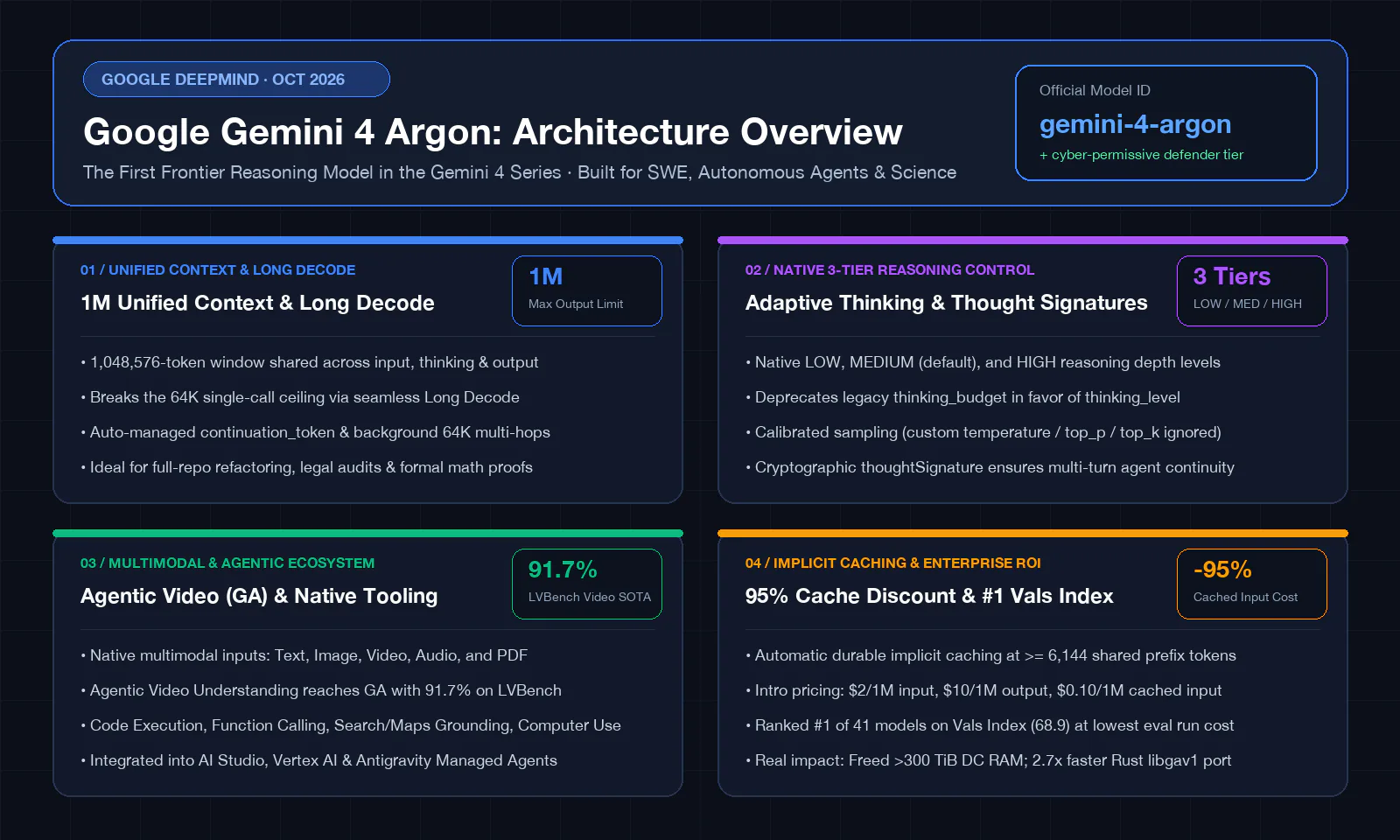
gemini-4-argon), the inaugural flagship model of the Gemini 4 series. Engineered specifically for deep, long-horizon work across complex real-world domains, Gemini 4 Argon unifies input, thinking, and output tokens within a single shared 1,048,576-token (1M) context window and shatters the traditional 64K output bottleneck via its breakthrough Long Decode architecture—enabling up to 1 million generated tokens in a single continuous trajectory. Setting new state-of-the-art (SOTA) records across long-horizon software engineering (DeepSWE v1.1: 77.9%), enterprise knowledge work (Vals Index: 68.9, #1 overall), long-video multimodal understanding (LVBench: 91.7%), and autonomous vulnerability remediation (CWE-bench v1: 68.0%), Gemini 4 Argon redefines what autonomous AI agents can accomplish in production.
1. Background: From Conversational Chatbots to Long-Horizon Autonomous Engineering
During the first wave of generative AI, frontier large language models (LLMs) competed primarily on single-turn conversational fluency and passive retrieval over large input contexts ("needle-in-a-haystack" comprehension). However, as autonomous AI agents moved into repository-scale software refactoring, defensive zero-day vulnerability discovery, formal scientific and mathematical proofs, financial modeling, and exhaustive legal due diligence, three structural bottlenecks emerged:
- The Output Token Ceiling: Most frontier models capped single-request generation between
32Kand64Ktokens. When tasked with multi-hour software migrations, exhaustive theorem proving, or generating hundreds of thousands of lines of code and documentation, models truncated mid-flight or lost global state across manual chunking loops. - Fragmented Context and Reasoning Budgets: Traditional architectures segregated input context windows from fixed "thinking budgets," preventing dynamic allocation of compute across reading, reasoning, and writing.
- The Dual-Use Cybersecurity Dilemma: Frontier models capable of autonomous vulnerability discovery pose dual-use risks if released without safeguards—yet overly rigid refusal guardrails hamper legitimate cyber defenders and white-hat security researchers.
To address these challenges, Google DeepMind introduced Gemini 4 Argon across a two-phase rollout between late September and mid-October 2026—delivering a frontier model built to solve your hardest problems.
2. Four Core Architectural Breakthroughs
As the first model in the Gemini 4 family, Gemini 4 Argon introduces four foundational upgrades across context management, long-horizon decoding, reasoning calibration, and context caching:
2.1 Unified 1,048,576-Token Shared Window & Long Decode
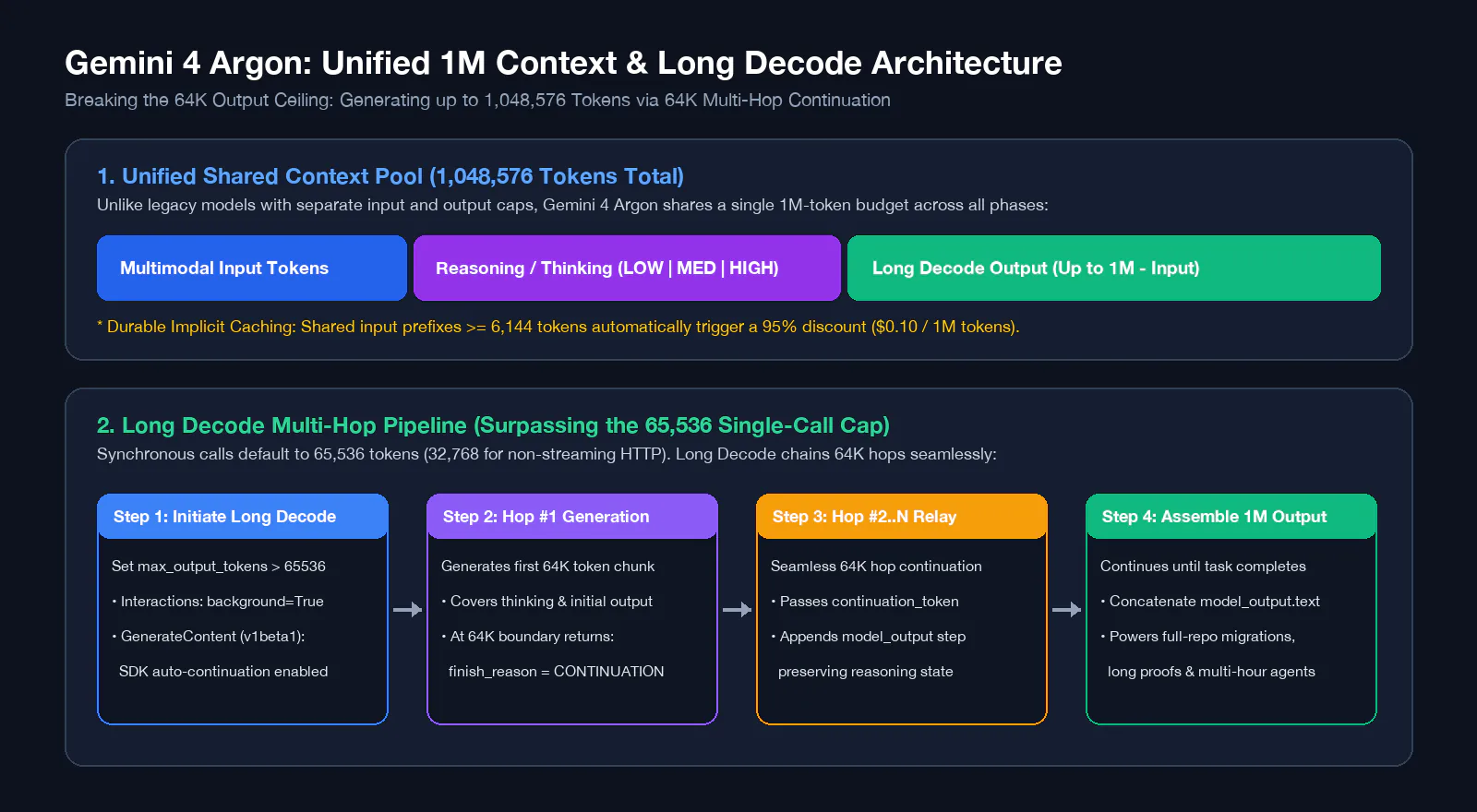
Unlike earlier generations that imposed separate ceilings on prompt inputs and model completions, Gemini 4 Argon's official specification introduces a Unified 1M-Token Context Window:
Total shared window = input tokens + thinking tokens + output tokens ≤ 1,048,576
Paired with this unified pool is Google's Long Decode mechanism:
- Standard Synchronous Mode: Streaming and synchronous requests generate up to 65,536 tokens by default (
32,768 tokensfor non-streaming direct HTTP calls), handling everyday coding and analytical workloads with zero code changes. - Million-Token Long Decode Mode: When a task demands more than 64K tokens of combined thinking and output, developers can set
max_output_tokens > 65,536(up to1,048,576minus input tokens) onGenerateContent(v1beta1) or enable background execution (background=True) on theInteractions API. - Seamless 64K Multi-Hop Continuation: Whenever generation reaches a 64K boundary, the model emits
finish_reason = CONTINUATIONalongside an encryptedcontinuation_token. The Google Gen AI SDK or Google's cloud backend automatically initiates the next 64K hop from the exact reasoning state where the previous hop stopped—allowing the model to chain hundreds of thousands of tokens into a single coherent trajectory.
2.2 Native Three-Tier Thinking Control (thinking_level) & Thought Signatures
According to the Google Cloud Gemini 4 Argon Developer Guide, Gemini 4 Argon retires manual token-count budgets (thinking_budget) in favor of semantic Three-Tier Reasoning Control (thinking_level):
Thinking Level (thinking_level) |
Target Workloads | Reasoning Behavior | Default On |
|---|---|---|---|
LOW |
High-throughput classification, rapid code completion, structured extraction | Minimizes internal reasoning steps for ultra-low time-to-first-token (TTFT) and high concurrency | Explicit opt-in |
MEDIUM |
Everyday software engineering, multi-step tool calling, enterprise analysis | Balances reasoning depth, latency, and token efficiency for optimal cost-performance | gemini-4-argon (Default) |
HIGH |
Full-repo refactoring, formal mathematical proofs, zero-day vulnerability hunting, scientific research | Unlocks maximum long-horizon reasoning depth, self-verification, and multi-hypothesis exploration | gemini-4-argon-cyber-permissive (Default) |
To guarantee reasoning stability over long trajectories, Gemini 4 Argon enforces strict API conventions:
- No Legacy Budget Parameters: Passing
thinking_budgetorthinking_level="MINIMAL"immediately returns anHTTP 400validation error. - Locked Optimal Sampling: Custom values for sampling parameters (
temperature,top_p, andtop_k) are automatically ignored by the server, preserving the model's reinforcement-learning-calibrated reasoning distribution. - Cryptographic
thoughtSignature: During multi-turn interactions and chained tool calls (functionCall), Argon emits signedthoughtSignaturetokens. Replaying these signatures across turns preserves latent reasoning state and prevents context drift across complex agentic workflows.
2.3 Full-Stack Multimodal Inputs & Agentic Video Understanding (GA)
Gemini 4 Argon advances Google's native multimodal architecture:
- Supported Input Modalities: Text, Image, Video, Audio, and PDF documents.
- Output Modality: High-density structured or unstructured Text & Code.
- Agentic Video Understanding (General Availability): Moving out of preview into GA on Gemini 4 Argon, Agentic Video Understanding enables the model to actively inspect, temporally localize, and reason over long-form video streams—achieving a state-of-the-art 91.7% on LVBench.
- Comprehensive Native Tooling: Built-in support for Code Execution, Function Calling, Grounding with Google Search, Grounding with Google Maps, URL Context, File Search, Structured Outputs, and Computer Use (Preview), with first-class integration into Google's Antigravity Managed Agent platform.
2.4 Default Durable Implicit Context Caching (95% Discount)
For workloads with large recurring prompt prefixes—such as repository-wide coding agents, multi-turn legal document analysis, and enterprise RAG pipelines—Gemini 4 Argon eliminates manual cache lifecycle management:
- Implicit Caching Only: Explicit context caching is no longer required or supported.
- Automatic Activation at 6,144 Tokens: Any shared prompt prefix of 6,144 tokens or more automatically benefits from durable implicit caching enabled by default.
- 95% Cost Reduction: Cached input tokens are billed at 95% off the standard input rate ($0.10 per 1M tokens during the introductory period, and $0.20 per 1M tokens thereafter).
3. Frontier Benchmarks & Real-World Engineering Impact
Across evaluations published by Google DeepMind and independent benchmark operators such as Vals AI, Gemini 4 Argon establishes leadership across software engineering, cybersecurity, enterprise knowledge work, and multimodal science.
3.1 Comprehensive Benchmark Scorecard
| Domain | Benchmark | Gemini 4 Argon Score | Standing / Comparison | What It Evaluates |
|---|---|---|---|---|
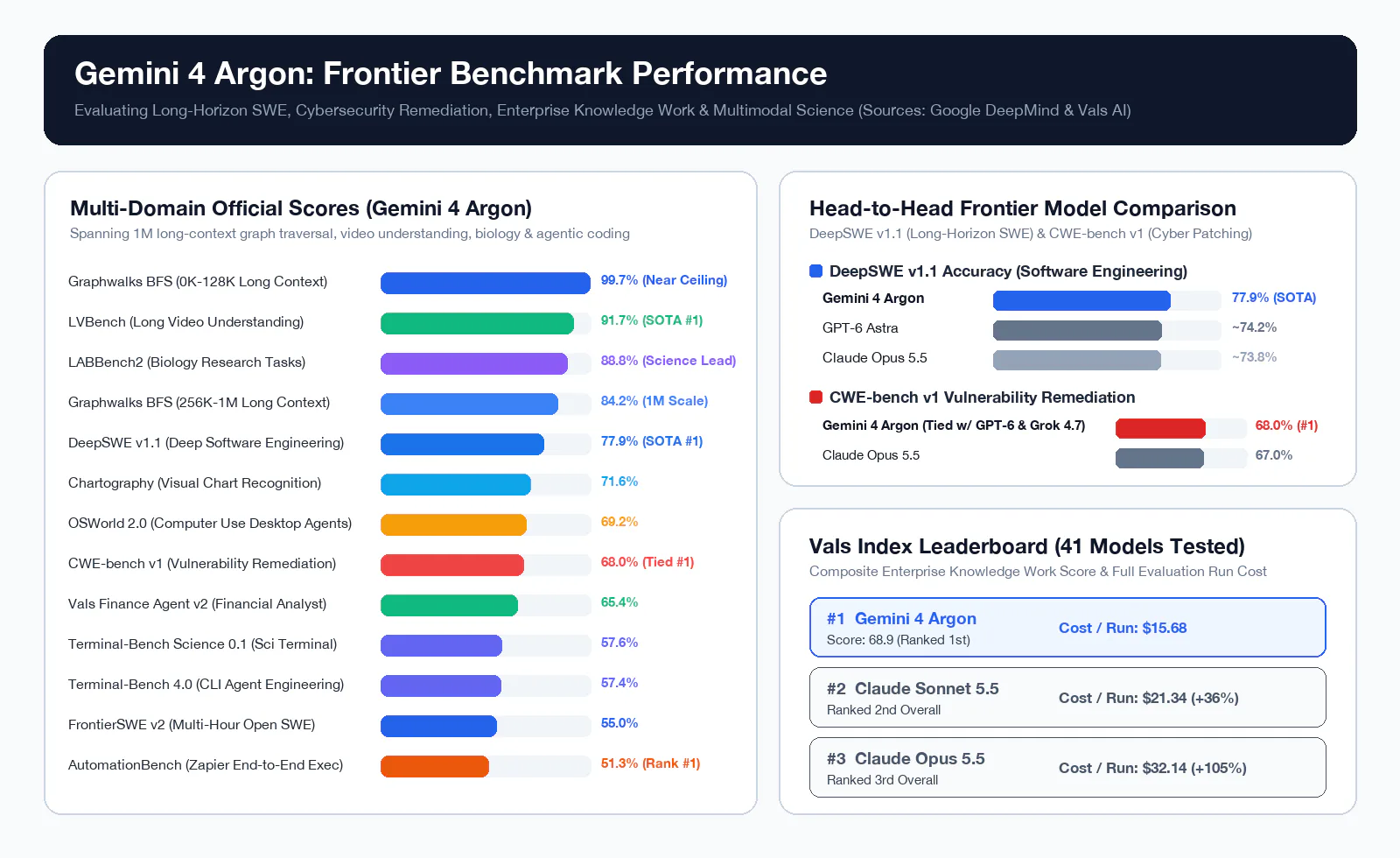
| Deep Software Engineering | DeepSWE v1.1 | 77.9% | SOTA #1 (Surpasses GPT-6 Astra & Claude Opus 5.5 at ~74%) | Deep real-world software engineering tasks using the mini-swe-agent harness |
| Long-Horizon SWE | FrontierSWE v2 | 55.0% | Frontier Tier | Open-ended software engineering projects lasting hours to tens of hours |
| CLI Agent Workflows | Terminal-Bench 4.0 | 57.4% | Frontier Tier | Long-horizon command-line planning, iteration, and tool coordination |
| Scientific CLI Agents | Terminal-Bench Science 0.1 | 57.6% | Scientific Computing Lead | Agentic terminal-based workflows across scientific research domains |
| Cybersecurity Patching | CWE-bench v1 | 68.0% | Tied #1 (Level with GPT-6 Astra & Grok 4.7; ahead of Claude Opus 5.5 at 67%) | Autonomous discovery, validation, and remediation of software security vulnerabilities |
| Enterprise Knowledge Work | Vals Index | 68.9 | Ranked #1 of 41 Models (Ahead of #2 Claude Sonnet 5.5 & #3 Claude Opus 5.5) | Composite enterprise benchmark spanning finance, law, tax, and business analysis |
| Financial Analysis | Vals Finance Agent v2 | 65.4% | Domain Leader | Core financial analyst workflows and financial data interpretation |
| Legal Workflows | Harvey Legal Agent Benchmark | 19.6% | Frontier Legal Benchmark | Complex legal workflow execution and multi-document legal reasoning |
| Business Automation | AutomationBench | 51.3% | Ranked #1 | Zapier's end-to-end tool-use benchmark across enterprise business functions |
| GUI Computer Use | OSWorld 2.0 | 69.2% | Frontier GUI Agent | Long-horizon desktop computer use and cross-application navigation (offline subset) |
| Long Video Understanding | LVBench | 91.7% | SOTA #1 | Comprehension and temporal reasoning over long-form real-world videos |
| Biology Research | LABBench2 | 88.8% | Scientific Research Lead | Real-world biological research, experimental design, and data analysis |
| Visual Chart Parsing | Chartography | 71.6% | High Precision | Visual chart recognition and quantitative data extraction |
| 1M Long-Context Traversal | Graphwalks BFS (0K–128K / 256K–1M) | 99.7% / 84.2% | Ultra-Long Context Stability | Breadth-first search F1 across 0K–128K (99.7%) and 256K–1M (84.2%) context ranges |
Cost-Efficiency Highlight: On the Vals Index across 41 models, Gemini 4 Argon not only claimed the #1 spot (68.9), but completed the full evaluation suite at $15.68 per run—compared to $21.34 for 2nd-place Claude Sonnet 5.5 and $32.14 for 3rd-place Claude Opus 5.5.
3.2 Three Landmark Production Case Studies
Beyond standardized benchmarks, Google's launch reports and industry analyses highlight three real-world production achievements:
- Freeing Over 300 TiB of Memory Across Google Data Centers: Deployed internally at Google, a team of Gemini 4 Argon agents autonomously profiled production infrastructure and identified subtle memory optimizations that will free more than 300 TiB of RAM across Google's global data fleet once fully rolled out.
- 2.7x Faster
libgav1Video Decoder Rewrite in Rust: Tasked with modernizing media infrastructure, Gemini 4 Argon performed an autonomous Rust rewrite of thelibgav1AV1 video decoder. The resulting Rust port produces bit-identical output while running 2.7x faster than the existing port. - Uncovering Critical Healthcare Software Vulnerabilities with Wiz:
Through the Fairwind Program and cloud security leader Wiz's Scan for Good initiative, defenders running
gemini-4-argon-cyber-permissiveautonomously uncovered, validated, and helped remediate a critical vulnerability exposing sensitive personal patient information in healthcare software used by hospitals worldwide.
4. API Pricing Structure & Two-Stage Rollout Roadmap
Gemini 4 Argon pairs a simplified flat-rate 1M context pricing model with a security-first two-stage release strategy.
4.1 Token Pricing (Eliminating the >200K Long-Context Surcharge)
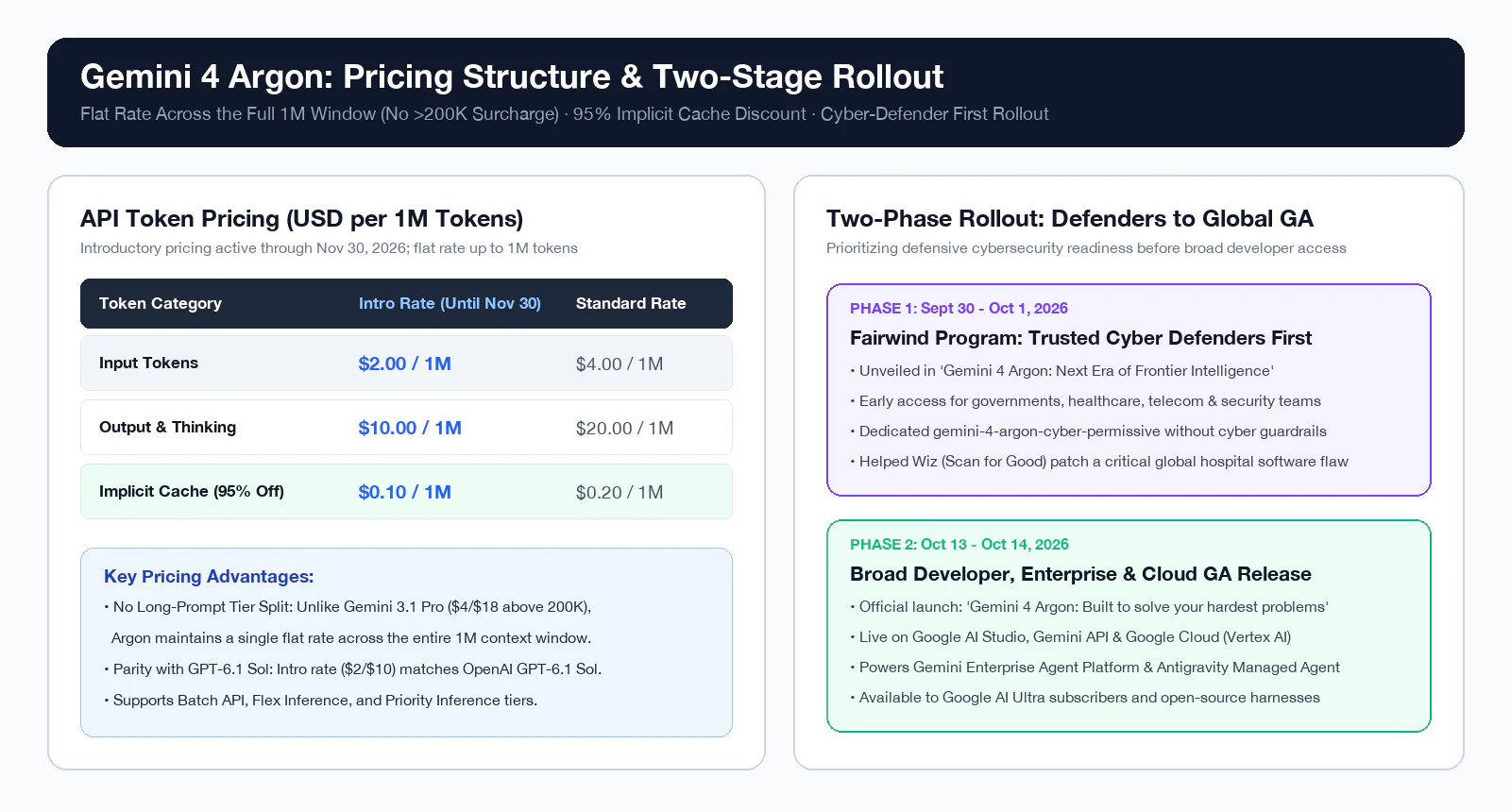
While previous Pro-tier models (such as Gemini 3.1 Pro) doubled token prices once prompts exceeded 200,000 tokens, Gemini 4 Argon charges a single flat rate across the entire 1,048,576-token window:
| Billing Dimension | Introductory Rate (Through Nov 30, 2026) | Standard Rate (Post-Introductory) | Notes |
|---|---|---|---|
| Input Tokens | $2.00 / 1M Tokens | $4.00 / 1M Tokens | Flat rate across 0–1M tokens; no >200K prompt surcharge |
| Output & Thinking Tokens | $10.00 / 1M Tokens | $20.00 / 1M Tokens | Covers internal reasoning (thinking) and final output tokens |
| Implicit Cached Input (95% Off) | $0.10 / 1M Tokens | $0.20 / 1M Tokens | Automatically applied to shared prefixes ≥ 6,144 tokens |
Developers can also select between Priority Inference (for mission-critical low-latency SLAs), Standard Synchronous/Streaming Inference, and Flex Inference / Batch API (for asynchronous large-scale workloads).
4.2 Two-Stage Rollout: Cyber Defenders First, Then Global GA
- Phase 1 (September 30 – October 1, 2026): Vetted Cyber Defenders via the Fairwind Program
Google unveiled Gemini 4 Argon in Gemini 4 Argon: Next Era of Frontier Intelligence, granting early access exclusively to vetted high-priority cyber defenders (governments, healthcare providers, telecommunications operators, and security partners like Wiz) via Google DeepMind's Fairwind Program. Trusted defenders and internal Google teams received
gemini-4-argon-cyber-permissive—a specialized variant with standard cyber refusal guardrails removed to accelerate defensive vulnerability discovery and patching. - Phase 2 (October 13 – October 14, 2026): Broad Developer & Enterprise GA
Following initial defensive deployments and safety evaluations, Google published Gemini 4 Argon: Built to solve your hardest problems and the Google Cloud availability announcement, opening
gemini-4-argonto developers, enterprises, and subscribers via Google AI Studio, the Gemini Developer API, Google Cloud Gemini Enterprise Agent Platform (Vertex AI), Antigravity Managed Agents, and Google AI Ultra.
5. Developer Quickstart & Code Examples
To get started with Gemini 4 Argon, upgrade to the latest Google Gen AI SDK (google-genai >= 2.30.1 for Python, @google/genai >= 2.29.1 for JavaScript/TypeScript):
pip install --upgrade "google-genai>=2.30.1"
Example 1: Deep Architecture Review with GenerateContent, Structured Outputs & HIGH Thinking
from pydantic import BaseModel, Field
from google import genai
from google.genai import types

class ArchitectureReview(BaseModel):
    component: str = Field(description="Service or module name")
    bottlenecks: list[str] = Field(description="Throughput or latency bottlenecks")
    recommended_changes: list[str] = Field(description="Concrete refactoring steps")

# Initialize Vertex AI / Enterprise Agent Platform client (or genai.Client() with GEMINI_API_KEY)
client = genai.Client(enterprise=True, project="YOUR_PROJECT_ID", location="global")

response = client.models.generate_content(
    model="gemini-4-argon",
    contents="Review a synchronous order-processing pipeline backed by a single primary database at 15,000 writes/sec.",
    config=types.GenerateContentConfig(
        response_mime_type="application/json",
        response_schema=ArchitectureReview,
        thinking_config=types.ThinkingConfig(thinking_level="HIGH"),
    ),
)
print(response.text)
Example 2: Surpassing the 64K Limit with Background Long Decode on the Interactions API
When a task requires generating hundreds of thousands of tokens in a single response—such as a rigorous mathematical proof or a full-module code migration—enable background=True and set max_output_tokens > 65536:
import time
from google import genai

client = genai.Client()

# Launch a background Long Decode interaction up to 262,144 tokens with HIGH thinking
interaction = client.interactions.create(
    model="gemini-4-argon",
    input="Write a complete, rigorous proof of the prime number theorem with all supporting analytic lemmas.",
    background=True,
    generation_config={
        "max_output_tokens": 262144,
        "thinking_level": "high",
    },
)

# Poll while the server automatically executes and chains 64K continuation hops
while interaction.status in ("in_progress", "queued"):
    time.sleep(5)
    interaction = client.interactions.get(id=interaction.id)

# Each 64K hop appends a model_output step; join them to reconstruct the full completion
full_text = "".join(
    content.text
    for step in interaction.steps
    if step.type == "model_output"
    for content in step.content
    if content.type == "text"
)
print("Status:", interaction.status)
print("Token Usage:", interaction.usage)
print(full_text)
6. Conclusion
Google Gemini 4 Argon marks a pivotal transition in frontier AI—moving the industry from passive 1M-token reading comprehension to active 1M-token deep reasoning and long-horizon generation. By combining a unified 1,048,576-token window, multi-hop Long Decode, native three-tier reasoning control (LOW / MEDIUM / HIGH), and 95%-off durable implicit caching, Gemini 4 Argon provides the foundational engine for autonomous software engineering, scientific discovery, enterprise knowledge automation, and proactive cyber defense.
Sources
- Gemini 4 Argon: Built to solve your hardest problems (Google)blog.google ↗
- Gemini 4 Argon model specification (Gemini API docs)ai.google.dev ↗
- Long Decode (Gemini API docs)ai.google.dev ↗
- Gemini 4 Argon developer guide (Google Cloud)docs.cloud.google.com ↗
- Gemini 4 Argon launch post (Google)blog.google ↗
- Gemini 4 Argon available on Google Cloud (Google Cloud Blog)cloud.google.com ↗
- Gemini 4 Argon pricing, benchmarks and rollout analysis (MIXED)mixed-news.com ↗
More news
- Tokenews launches a directory of AI models, makers and products
Every tracked AI model, maker and provider now has its own page with real per-token prices, plan contents and leaderboard scores.